North Orange County sits over massive supercolonies of Linepithema humile (Argentine ants), which drive seasonal migrations into domestic living spaces. In neighborhoods like West Anaheim and The Colony Historic…
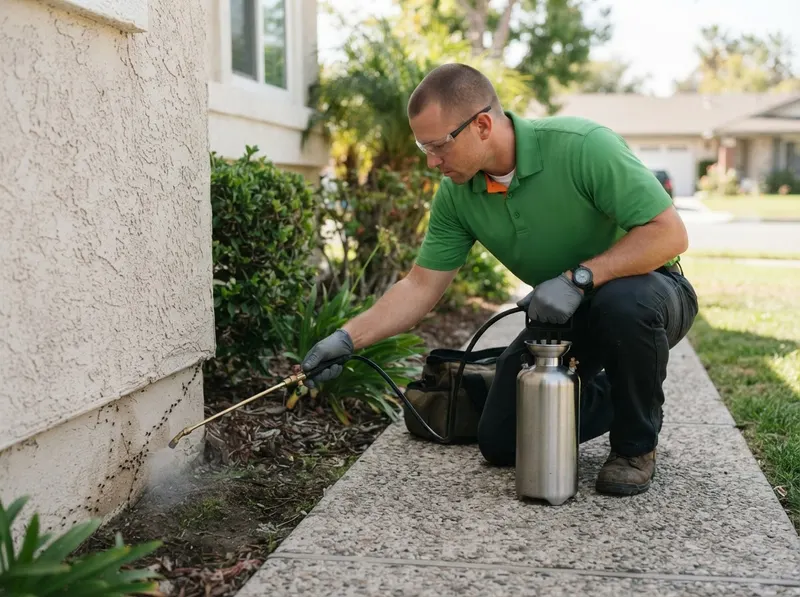
North Orange County sits over massive supercolonies of Linepithema humile (Argentine ants), which drive seasonal migrations into domestic living spaces. In neighborhoods like West Anaheim and The Colony Historic District, older foundations and unsealed raised-floor crawl spaces allow foraging columns to track moisture lines into kitchens and bathrooms during dry summer heat or sudden winter rains. In the clay soils of Anaheim Hills and near riparian zones like Oak Canyon Nature Center, outdoor colonies nest along hardscape borders, driveway seams, and landscape irrigation lines. Over-the-counter repellent sprays fracture these foraging lines, triggering a biological response known as budding where one colony splits into multiple distinct reproductive queens throughout home wall voids. Professional barrier science bypasses this defensive splitting by utilizing slow-acting non-repellent chemistries that worker ants carry back deep into the sub-soil nesting chambers to collapse the primary queen.
Selecting the right structural ant protocol depends on the specific nesting habitat and architectural profile of the residence. Modern multi-story builds and dense planned developments in the Platinum Triangle and near the Anaheim Resort District benefit from exterior envelope banding, treating three feet up the exterior stucco wall and three feet out across adjacent flatwork. Conversely, properties near Hermosa Park, Pecan Park, or Sherwood Forest & Thistle often require dual-phase treatment: non-staining micro-droplet gel baits strategically tucked inside cabinetry wall penetrations alongside targeted soil drenching around perimeter landscaping beds. The operational trade-off centers on treatment persistence versus immediate knockdown: fast-kill sprays stop surface bugs instantly but leave subterranean queens viable, whereas systematic transfer compounds take 3 to 7 days to wipe out the entire colony network permanently.
Household occupant safety remains standard across every application. Materials selected for indoor crack-and-crevice placements are formulated to bind tightly to base surfaces, eliminating airborne residues and preventing contact transfer to domestic pets, cats, dogs, or small children once dry within 30 to 60 minutes. Structural inspections clarify that a localized ant sighting in a single pantry does not automatically require a perpetual monthly contract. Single-incident eradications address acute population spikes, while bi-monthly exterior maintenance programs maintain continuous non-repellent perimeter defense barriers against external re-invasion across expansive property lines.
Every job gets a firm, written price after a free on-site visit.
Tell us about your ant control job in Anaheim and we'll send a clear, written quote, usually the same day.
 Golden Finch Pest Control